
Table of Contents
What Is an Inverter Scroll Compressor?
En inverter scroll compressor is a variable-speed DC refrigerant pump specifically designed for 12V and 24V aire acondicionado para aparcamientos. Commercial semi-trailer trucks, RVs, and heavy-duty construction vehicles rely on scroll technology to provide reliable cab cooling, which can reduce power consumption during overnight parking.
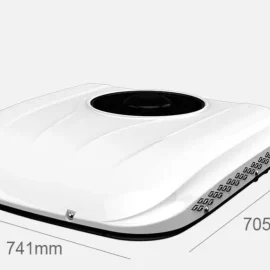
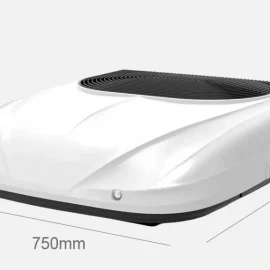
We are a professional and reliable manufacturer of parking air conditioners based in China. We offer two versions of our low-profile Ferrari-style inverter truck AC: a 12V 1800W model y a 24V 2100W model. The MOQ is 5 units. Contact us now for a free, quick quote!
What Is an Inverter Scroll Compressor in a Parking AC?
Portable inverter-driven scroll compressors combine a brushless permanent magnet motor with a precision-machined spiral scroll. The DC motor, inverter controller board, and scroll pump are enclosed within a sealed metal housing. Traditional belt-driven truck compressors draw mechanical power directly from the main diesel engine’s crankshaft during operation.
Electric parking compressors connect directly to an auxiliary 12V or 24V battery pack, so the air conditioning can operate independently when you shut off the main engine at a rest stop. The scroll design eliminates the pistons, connecting rods, and reed valves found inside older reciprocating compressors, reducing internal mechanical friction by 30% and keeping noise levels below 45 decibels.
How Does a DC Inverter Scroll Compressor Work?
The electronic control unit draws 12V or 24V DC power directly from the vehicle’s battery pack. The inverter circuit board then converts the DC power into three-phase AC power at a variable frequency. Inside the compression chamber, one spiral scroll remains stationary while the other moves in an eccentric orbit around it. The rotating scroll does not complete a full rotation but rather slides along a tight circular path. R134a or R410A enters the outer suction chamber between the two intermeshing metal spirals.
As the rotational motion continues, the crescent-shaped air pocket smoothly contracts and moves toward the central port. The pressure and temperature of the refrigerant rise steadily without any violent piston pressure pulsations. Finally, the high-pressure gas is discharged through the central exhaust port and flows into the outdoor condenser coil. When the cabin temperature reaches the thermostat setting you have selected, the inverter-controlled scroll compressor’s speed drops to a low-speed, energy-saving mode of 1,500 revolutions per minute, continuously drawing 10 to 15 amps while maintaining cabin comfort.
Operating Stages of a 24V Parking AC Scroll System
| Operating Stage | Velocidad del compresor | 24V DC Current Draw | System Action & Cooling Output |
|---|---|---|---|
| Soft Start Ramp-Up | 800 – 1,200 RPM | 8 – 12 Amps | Eliminates startup inrush surge on batteries |
| Max Cooldown Mode | 3,600 – 4,500 RPM | 30 – 38 Amps | Rapidly pulls hot cabin down from 110°F |
| Cruise / Normal Mode | 2,200 – 2,800 RPM | 18 – 24 Amps | Balances steady heat rejection under midday sun |
| Night Eco Sleep Mode | 1,200 – 1,800 RPM | 9 – 14 Amps | Maintains 72°F sleeper temperature overnight |
Obtenga un presupuesto ahora
Ofrecemos calentadores de aparcamiento y refrigeradores de aparcamiento en una variedad de colores.Obtenga un presupuesto rápido y gratuito hoy.Como fabricante directo de equipos originales,reducimos aún más sus costes.Eliminamos intermediarios y primas de marca,eliminando capas adicionales de intermediarios.Tenemos el artículo en stock y podemos embalarlo y enviarlo en cualquier momento.
Mobile Parking AC vs Household AC: Core Differences
Many technicians assume a parking unit uses the exact same inverter scroll compressor as a residential mini-split.However, the requirements for mechanical, electrical, and lubrication engineering design in a moving vehicle environment are entirely different. Residential air conditioners use high-voltage 115V or 230V AC power; they must first rectify the mains AC power into DC, and then invert it back into a variable three-phase power supply. In contrast, automotive inverter-driven scroll compressors are powered directly by low-voltage 12V or 24V DC battery power. Due to the lower input voltage, the automotive inverter circuit board must be capable of withstanding high currents ranging from 40 to 65 amps.
Residential compressors are mounted on flat concrete bases and use tall, vertical oil pans, whereas truck-mounted air conditioning units must withstand highway impacts of 6G to 8G, bumpy roads, and chassis flex. Vehicle-mounted scroll units employ horizontal oil pans, reinforced cast brackets, and elastic vibration isolators to minimize the impact of these factors on the machinery as much as possible.
Under summer sunlight, the temperature on a dark truck roof can reach 140 degrees Fahrenheit, causing condenser pressure to exceed 320 pounds per square inch; this necessitates the use of a thicker steel housing and high-viscosity synthetic POE68 lubricant.
Mobile Parking AC vs Household AC Scroll Compressor Comparison
| Technical Parameter | Parking AC Inverter Scroll Compressor | Household AC Scroll Compressor | Real-World Operational Impact |
|---|---|---|---|
| Power Supply Input | 12V / 24V / 48V Direct Current (DC) | 115V / 230V Alternating Current (AC) | Mobile units run directly off battery banks |
| Structural Orientation | Low-profile horizontal or compact vertical | Tall stationary vertical cylinder | Horizontal design fits slim 6-inch roof shrouds |
| Resistencia a las vibraciones | Rated for 6G – 8G continuous road shock | Rated for stationary pad mounting (<0.5G) | Mobile springs prevent internal scroll vane fractures |
| Operating Tilt Limit | Up to 15° continuous vehicle incline | Must remain within 2° of vertical plumb | Pressurized oil pump protects mobile bearings on hills |
| Ambient Temp Rating | Up to 131°F (55°C) rooftop ambient | Up to 115°F (46°C) outdoor ambient | Mobile units avoid thermal cutouts on asphalt lots |
Common Parking AC Compressor Problems and Solutions
Even a heavy-duty inverter scroll compressor can fail if installers ignore wiring sizing or refrigerant charge rules. Fortunately, fleet mechanics can resolve common operational faults using systematic diagnostic checks and targeted upgrades.
1. Voltage Drops and Inverter Scroll Compressor Cutouts
A power cable that is too thin can cause a significant voltage drop between the truck battery and the compressor controller. When the input voltage to a 12V device falls below 10.5V, the drive board triggers a low-voltage lockout code. Furthermore, excessive resistance can cause the inverter’s MOSFET chips to overheat, resulting in sudden thermal shutdowns on hot afternoons. To resolve this issue, use a dedicated 2 AWG or 4 AWG solid copper cable to connect directly to the battery terminals, clean corroded battery terminals quarterly, and protect the positive circuit with an 80-amp MIDI fuse.
2. Oil Starvation on Steep Parking Grades
Parking a semi-trailer truck or RV on a steep slope can cause the horizontal compressor oil pan to tilt. When the cab is tilted more than 15 degrees, synthetic oil accumulates away from the internal shaft suction port. The rotating scroll plate will run dry, producing a metallic grinding noise and causing rapid wear on the scroll tips. Be sure to park the vehicle on level ground or use wheel chocks before leaving the cooling system running overnight.
3. Liquid Slugging inside an Inverter Scroll Compressor
Overcharging of refrigerant or a clogged evaporator filter can cause liquid refrigerant to enter the suction line. Since liquid is incompressible, untreated liquid refrigerant will violently impact the rotating scroll walls inside the inverter scroll compressor. Although axial flexible springs can absorb small amounts of liquid droplets, the impact of large amounts of liquid can permanently damage the cast-iron scroll vanes. To prevent liquid slugging, use an electronic scale to precisely measure the refrigerant charge (to the nearest ounce). As a professional manufacturer of parking air conditioners in China, we recommend cleaning the interior return air filter every two weeks to maintain strong airflow through the evaporator coils.
4. Blocked Condensers and High-Pressure Trips
Insects, poplar seeds, and diesel particulates from the road can accumulate densely between the fins of the outdoor condenser coils. Restricted airflow through the condenser traps heat in the refrigerant circuit, causing the discharge pressure to rapidly surge to over 350 PSI. The variable-frequency controller detects excessive motor torque and shuts down the variable-frequency scroll compressor to prevent it from burning out. Once a month, use a low-pressure foam coil cleaner and a soft-hose spray to clean the fins of the outdoor condenser.
5. Internal Moisture and Acid Corrosion
Omitting the vacuum procedure during installation can cause moist air to remain trapped inside the copper refrigeration lines. Moisture reacts chemically with polyol ester oil and R134a refrigerant, producing corrosive hydrofluoric acid inside the pump. After several months, the acid will strip the copper plating from the tube walls and deposit conductive sludge on the motor windings. To prevent acid corrosion damage, be sure to evacuate the system to 500 micrometers before charging with refrigerant. Be sure to install a new molecular sieve dryer filter every time a sealed refrigeration circuit is opened.
Diagnostic Troubleshooting for Mobile Inverter Scroll Compressor
| Fault Symptom / Error Code | Probable Root Cause | Diagnostic Verification Test | Corrective Repair Solution |
|---|---|---|---|
| Low Voltage Alarm (E1/E2) | Thin wiring or corroded battery lugs | Measure voltage at ECU under load | Upgrade to 2/4 AWG copper wire & clean lugs |
| Metallic Grinding Noise | Oil starvation or steep cab tilt | Check vehicle angle & oil charge level | Level vehicle within 15° & add POE-68 oil |
| Over-Current Shutdown (E3) | Condenser blockage or overcharge | Check high-side gauge (>350 PSI) | Wash condenser fins & recover excess gas |
| Compressor Fails to Spin | Burned inverter board or phase loss | Test 3-phase motor pin resistance | Replace inverter driver module or pump |
Póngase en contacto con nosotros
- RM901 No.22 Tangjiaqiao Road Wenzhou China
- +86 138 1973 9327
- [email protected]
- https://www.autosparesupplier.com/
Compartir