
Table of Contents
Why R134a Replacing R12 in Parking AC?
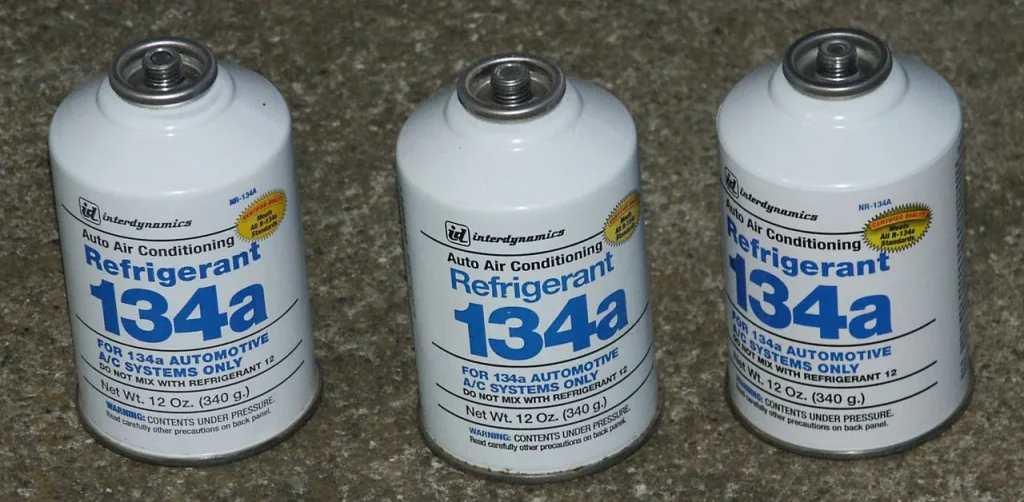
In parking air conditioners, R134a is replacing R12. But why don’t we use R12 anymore?For decades, older portable air conditioners relied on R12 Freon, but R12 was later found to cause severe damage to the ozone layer, leading to an international ban on its production and use. Reputable manufacturers have switched all modern 12V and 24V parking air conditioners to the chlorine-free R134a refrigerant.
Looking For A Wholesaler of R134a Parking Air Conditioners?
Ozone Layer Protection
R134a replacing R12 both prevents ozone depletion in the upper atmosphere and maintains strong cab cooling performance. R12 is a chlorofluorocarbon (CFC) gas containing destructive chlorine atoms; when leaked R12 reaches the upper atmosphere, ultraviolet radiation breaks these chlorine bonds. A single chlorine atom can destroy more than 100,000 protective ozone molecules.
Scientists have set the Ozone Depletion Potential (ODP) of R12 at 1.0 as a baseline. R134a is a hydrofluorocarbon compound that contains no chlorine atoms, and its ODP is exactly 0.0. The Global Warming Potential (GWP) of R134a has been reduced from 10,900 to 1,430.
Global Legality and the Montreal Protocol Ban
Strict international laws accelerated the replacement of R12 with R134a in truck and RV manufacturing facilities worldwide. In 1987, world leaders signed the Montreal Protocol to phase out substances that deplete the ozone layer. Subsequently, the United States and the European Union banned the production of new R12 in January 1996.
Refrigerant Availability and Fleet Maintenance Costs
Supply shortages and high prices have also driven and solidified this shift in the day-to-day operations of vehicle fleets. Factories stopped producing R12 thirty years ago, and the remaining supply comes entirely from recycled stock; today, a 30-pound bottle of recycled R12 sells for over $900. Meanwhile, brand-new R134a is still widely available at every auto parts store and truck service station, with a 30-pound bottle costing only about $250 to $350.
R134a recovery units, manifold pressure gauges, and service fittings are also widely available at roadside repair shops. If an aging R12 system develops a pinhole leak, recharging the refrigerant can quickly drain a fleet’s maintenance budget.
R12, R134a, and Next-Gen Parking AC Refrigerants
| Refrigerant Grade | Chemical Class | Ozone Depletion (ODP) | Global Warming (GWP) | Lubricant Oil Type | Legal & Market Status |
|---|---|---|---|---|---|
| R12 (Freon) | CFC | 1.0 (High) | 10,900 | Mineral Oil | Banned (1996); scarce recycled stock |
| R134a | HFC | 0.0 (Safe) | 1,430 | POE-68 / PAG | Current standard; phasing down |
| R1234yf | HFO | 0.0 (Safe) | < 1 (0.5) | POE / Special PAG | New OEM standard; A2L mild flammable |
| R290 (Propane) | Hydrocarbon | 0.0 (Safe) | 3 | POE / Mineral | Emerging eco-option; A3 flammable |
How to Retrofit Legacy R12 Systems to R134a Safely
Drivers of vintage trucks or classic RVs often ask how to handle outdated R12 air conditioning systems. Fortunately, technicians can follow a standardized repair process to replace R12 refrigerant with R134a refrigerant.
As a professional manufacturer and wholesaler of parking air conditioners in China, we do not recommend that you perform the following procedure yourself, as it is likely to damage your equipment. Please seek assistance from a professional technician.
- Safely discharge all remaining R12 gas into an approved recovery tank.
- Flush out the old mineral oil, as mineral oil is incompatible with R134a refrigerant. Electric parking air conditioner scroll compressors require synthetic POE-68 polyol ester oil to protect the motor windings. Please note that standard PAG oil is conductive and will damage the motor of a hermetically sealed DC compressor.
- Replace all rubber O-rings with green HNBR seals to prevent chemical swelling and leaks.
- Install a new drier filled with XH-7 or XH-9 desiccant beads.
- Screw R134a quick-disconnect fittings onto the high-pressure and low-pressure service ports.
- Evacuate to a 500-micron vacuum and charge with R134a refrigerant to 80% of the original R12 refrigerant weight.
R12 to R134a Parking AC Retrofit Checklist
| Retrofit Step | Required Component / Action | Technical Specification | Why It Matters |
|---|---|---|---|
| Oil Flush & Swap | Drain mineral oil; add POE-68 | Non-conductive synthetic ester | Prevents compressor oil starvation & shorts |
| Seal Upgrade | Install green HNBR O-rings | Hydrogenated nitrile rubber | Stops R134a permeation leaks |
| Desiccant Change | Replace receiver-drier | XH-7 or XH-9 molecular sieve | Prevents moisture and acid formation |
| Charge Calibration | Weigh refrigerant charge | 80% to 85% of R12 weight | Prevents excessive high-side head pressure |
What Is the Future Refrigerant After R134a?
While R134a replacing R12 solved ozone depletion, R134a still traps significant atmospheric heat.R134a has a global warming potential 1,430 times that of carbon dioxide, and the EU’s MAC Directive and the U.S. EPA’s AIM Act are gradually phasing out the production of R134a.
- R1234yf can directly replace R134a used in modern passenger car and commercial truck manufacturing. R1234yf has a GWP value below 1, and its operating pressures are very similar to those of R134a. However, R1234yf is classified as A2L for flammability, and its price per pound is three times that of R134a.
- R290 propane offers excellent thermodynamic efficiency and has a GWP value of only 3. Currently, many European and Asian parking air conditioner manufacturers are testing R290 in compact rooftop units. However, it is classified as an A3-class highly flammable refrigerant, and its charge must be strictly limited to less than 150 grams.
- R32 has high cooling capacity and a moderate global warming potential, providing a temperature rise of 675 for heavy machinery.
Future Parking AC Refrigerants Comparison & Buyer Guidance
| Future Gas | ASHRAE Safety Class | Operating Pressure | Key Advantage | Primary Adoption Challenge |
|---|---|---|---|---|
| R1234yf | A2L (Mildly Flammable) | Similar to R134a | Easy OEM transition; GWP < 1 | High refrigerant cost ($60+/lb) |
| R290 | A3 (Higher Flammability) | 10% higher than R134a | High efficiency; GWP = 3 | Requires spark-proof relays & small charge |
| R32 | A2L (Mildly Flammable) | 50% higher than R134a | Strong heat rejection in deserts | Requires thicker copper tubing & compressors |
Practical Buying Advice for Fleet Managers and RV Owners
For existing vehicles, purchasing a high-quality R134a parking air conditioner remains entirely legal and practical. Repair parts, POE-68 lubricant, and R134a cylinders will continue to be available well into the 2030s, facilitating maintenance.
Please ensure your unit uses heavy-gauge C12200 copper tubing and a brushless DC inverter fan. High-quality copper tubing is better equipped to handle future refrigerant pressure requirements than thin aluminum microchannels.
Latest Products
Свяжитесь с нами сейчас
- RM901 No.22 Tangjiaqiao Road Wenzhou China
- +86 138 1973 9327
- [email protected]
- https://www.autosparesupplier.com/
Share