
Can A Motorhome AC Run on Solar Power?
Running a motorhome ac on solar power is entirely possible with a properly sized off-grid system.The advent of modern lithium-ion battery technology and high-efficiency inverters has made off-grid cooling possible,so RV owners no longer need noisy diesel generators to stay cool during hot summers.Solar panels can charge the battery bank,which then continuously powers the parking air conditioner;matching power generation with cooling demand is essential to ensure smooth off-grid operation.
Can Solar Power Run a Motorhome AC System?
Yes,solar power can run a motorhome ac,but solar panels alone cannot power it directly.Solar panels capture sunlight and store electrical energy in a high-capacity lithium-ion battery bank.A high-power inverter converts direct current (DC) to alternating current (AC) for use by the refrigeration compressor.The battery bank acts as a buffer during the compressor’s sudden high-current startup.
Traditional rooftop air conditioners consume between 1,200 and 1,800 watts during continuous cooling operation,so your solar array must generate enough watt-hours each day to replenish the battery power consumed.Installing a soft starter can reduce the compressor’s initial power surge by up to 65%,providing highly effective protection for your equipment.
Power Requirements for Motorhome AC Units
| AC Unit Type | Starting Surge Power | Continuous Running Power | Recommended Battery Capacity |
|---|---|---|---|
| 13,500 BTU Rooftop | 2,800 – 3,500 Watts | 1,200 – 1,500 Watts | 400Ah – 600Ah Lithium |
| 15,000 BTU Rooftop | 3,300 – 4,000 Watts | 1,500 – 1,800 Watts | 600Ah – 800Ah Lithium |
| 12V/24V Inverter AC | 500 – 800 Watts | 300 – 800 Watts | 200Ah – 400Ah Lithium |
Get A Quote Now
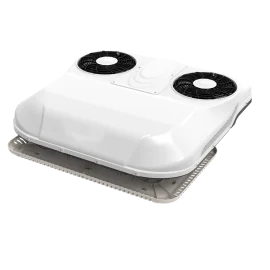
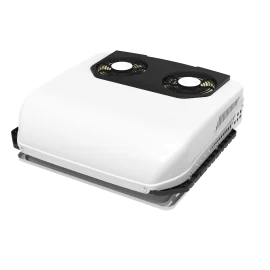
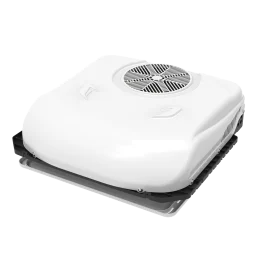
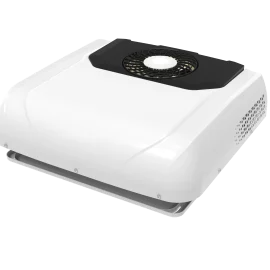
We offer parking heaters and parking coolers in a variety of colors.Get a free, fast quote today.As a direct original equipment manufacturer,we further reduce your costs.Eliminate middlemen and brand premiums,cutting out additional layers of intermediary.We have the item in stock and can pack and ship it at any time.
Key Components of a Solar Power Setup
Operating a motorhome ac off-grid requires five essential electrical hardware components working together seamlessly.
- First,high-efficiency monocrystalline silicon solar panels continuously absorb solar energy generated by direct sunlight.
- Second,the MPPT charge controller regulates the input voltage to charge the lithium-ion battery safely and efficiently.
- Third,deep-cycle lithium iron phosphate batteries store a large amount of electrical energy for use at night.Even under high loads,these lithium batteries provide a stable current without voltage drop.
- In addition,a pure sine wave inverter converts the 12-volt battery power into clean 120-volt household electricity.
- Finally,a digital soft starter protects the inverter’s electronic components by suppressing dangerous power surges generated when the compressor starts.
| Hardware Component | Primary Technical Function | Recommended Sizing Standard |
|---|---|---|
| Monocrystalline Solar Panels | Collects solar energy from sunlight | 800W to 1,200W roof array |
| MPPT Charge Controller | Optimizes solar charging efficiency | 80A – 100A rating |
| LiFePO4 Lithium Battery | Stores deep-cycle electrical power | 400Ah to 800Ah bank |
| Pure Sine Wave Inverter | Converts DC power to AC electricity | 3,000W continuous rating |
| Digital Soft Starter | Suppressing power surges,protect electronics | 1P – 1.5P, 800W-1200W |
Step-By-Step Guide to Powering Motorhome AC via Solar
Building an effective system to run your motorhome ac requires following a precise installation sequence.
- First,calculate the total daily power consumption (watt-hours) based on the estimated cooling time to determine the battery capacity needed to handle hot summer afternoons.
- Next,install the digital soft starter directly inside the roof-mounted air conditioning housing.The soft starter allows the lower-power 3,000-watt inverter to smoothly start the high-power compressor motor,thereby preventing the inverter from suddenly tripping due to overload during high-temperature cooling cycles.
- Use tilt brackets to mount the solar panels on the roof at the optimal angle.Tilted panels can effectively absorb more sunlight in the early morning and late afternoon.
- Finally,securely connect thick copper wires to the battery bank,charge controller,and inverter.
Troubleshooting Common Solar Power Climate Issues
Off-grid systems occasionally face operational challenges when running high-draw climate equipment under heavy loads.If the inverter shuts down unexpectedly,check the charge level of the lithium-ion battery.A low-voltage cut-off will trigger a protection mode to safeguard the integrity of the battery’s internal cells.Check the glass surface of the solar panels for thick layers of dust,leaves,or shaded areas,as these can reduce daily charging energy by up to 30 percent.Inspect the thick cable connectors for loose screws or thermal corrosion;tightening the connections can eliminate unnecessary resistance and voltage drops in the system.
Common Solar Power AC Faults and Technical Solutions
| Observed System Fault | Probable Technical Cause | Recommended Solution Action |
|---|---|---|
| Inverter Overload Alarm | High compressor startup surge | Install electronic soft starter kit |
| Battery Drains Quickly | Undersized lithium capacity | Add additional LiFePO4 battery modules |
| Low Solar Charge Rate | Dirty panels or poor tilt angle | Clean glass surface and adjust tilt angle |
In short,using solar power to run your RV’s air conditioner allows you to completely break free from campground power connections.By investing in lithium-ion batteries and ample solar panels,you can enjoy quiet,sustainable comfort anywhere.Campers can enjoy cool air inside their RVs without relying on noisy gas generators or expensive power outlets.High-efficiency inverter air conditioning units significantly reduce daily power consumption compared to traditional models.Upgrade your off-grid system to enjoy reliable cooling performance for years to come.Start planning your solar air conditioning upgrade today and experience peaceful,eco-friendly off-grid travel!
Contact Us Now
- RM901 No.22 Tangjiaqiao Road Wenzhou China
- +86 138 1973 9327
- [email protected]
- https://www.autosparesupplier.com/
Share