
Table of Contents
How To Improve The Cooling Performance of An RV AC?
You can improve the cooling performance of your RV AC by eliminating airflow restrictions and managing exterior heat loads.During the summer peak season,when the ambient temperature exceeds 95 degrees Fahrenheit (approximately 35 degrees Celsius),standard rooftop air conditioners often struggle to function properly.RVs have thin cabin walls with minimal insulation and large glass windows,which quickly absorb intense solar heat.On hot afternoons,the cooling system may run continuously but still fail to reach the set temperature.
Internal mechanical bottlenecks can also reduce airflow and lower overall heat exchange efficiency.If you’re using a parking air conditioner,we recommend paying close attention to equipment maintenance and insulation to maximize comfort.To help you get the most out of your roof-mounted air conditioner,we’ve compiled 11 practical tips to improve its cooling performance.
Understanding Delta T to Improve RV AC Cooling Performance
ΔT represents the temperature difference between the return air intake and the supply air outlet.For a properly functioning RV air conditioning unit,ΔT should be between 16 and 22 degrees Fahrenheit.If the return air temperature is 80 degrees Fahrenheit,the supply air outlet should blow air at 60 degrees Fahrenheit.
However,air leaks and dirt buildup on the condenser coils can cause this temperature difference to drop to 10 degrees Fahrenheit or even lower.In this case,the compressor has to work harder,unnecessarily consuming excessive amounts of electricity.
Operational Benchmarks to Improve RV AC Cooling Performance
| Operating Parameter | Factory Target Spec | Degraded System Reading | Corrective Action |
|---|---|---|---|
| Delta T Split | 16°F to 22°F drop | Under 12°F drop | Clean coils and seal plenum |
| Return Airflow Volume | 300 to 450 CFM | Below 200 CFM | Clean or replace return filters |
| Compressor Inrush Current | 45 to 60 Amps surge | High voltage dip | Install electronic soft starter |
| Exterior Condenser Temp | 15-25°F above ambient | 40°F+ above ambient | Straighten fins and wash coils |
Get A Quote Now
We offer parking heaters and parking coolers in a variety of colors.Get a free, fast quote today.As a direct original equipment manufacturer,we further reduce your costs.Eliminate middlemen and brand premiums,cutting out additional layers of intermediary.We have the item in stock and can pack and ship it at any time.
11 Ways to Improve the Cooling Performance of an RV AC
Through targeted mechanical and environmental adjustments,you can restore optimal cooling performance in your car.Follow these 11 steps to gradually improve the efficiency of your AC system.
Methods for Operating the AC and the Cabin
1. Clean or Replace RV AC Filters
A clogged air intake filter severely restricts the flow of return air into the evaporator coil assembly,forcing the blower motor to work harder,which reduces air circulation in the cabin.On humid summer afternoons,the evaporator coil is likely to freeze over.
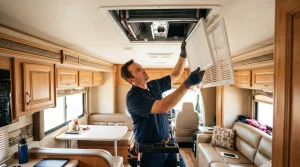
Remove the return air vent grille from the plastic headliner and carefully take out the foam or pleated filter element.Wash the filter every two weeks with warm water and mild dish soap.After washing,be sure to let the filter dry completely before sliding it back into the headliner assembly.It is recommended to replace disposable filters monthly during peak travel seasons to ensure unobstructed airflow.
2. Seal the RV AC Plenum and Divider Baffle
Air leaks between the supply air chamber and the return air duct can severely affect cooling performance.The thin metal partition separating the cold air from the warm air inside the vehicle is prone to damage,causing cold air to leak into the return air chamber.As a result,the air conditioning unit will cool the cold air unnecessarily,causing the compressor to start and stop frequently.
Open the ceiling air distribution box and inspect the partition with a high-intensity flashlight. Use professional HVAC aluminum foil tape to tightly seal all perimeter gaps and metal seams.
Please note:
Never use fabric tape,as high summer temperatures will cause the rubber adhesive to deteriorate within a few weeks.
3. Clean RV AC Coils, Fins, and Registers
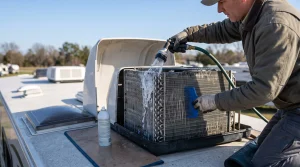
A dirty outdoor condenser coil prevents heat from being effectively dissipated into the outside air.Climb onto the roof of the RV,unscrew the plastic aerodynamic cover,and you’ll see the condenser coil and fan motor. Thoroughly spray the aluminum coils with a non-acidic foam coil cleaner and low-pressure water.
Never use a pressure washer,as the powerful water jet can instantly bend the fragile aluminum fins.Then,use a plastic HVAC fin comb to straighten any bent metal fins to restore even airflow.If possible,use a no-rinse foam spray to clean the internal evaporator coils and remove accumulated dust.
4. Optimize Interior Airflow to Improve Cooling Performance
Proper indoor air circulation ensures that the entire mobile living space cools down quickly.As a camper,the first thing you should do after arriving at the campsite is to open the roof’s direct-exhaust vents.The direct-exhaust vents expel the maximum airflow directly beneath the RV,enabling rapid initial cooling.Once the interior temperature has dropped to a comfortable level,switch back to ducted roof ventilation.If you have adjustable roof vents,direct the airflow toward the main living and sleeping areas, and keep the doors to the bedroom and bathroom open to maintain smooth return air circulation.
5. Inspect the RV AC Roof Gasket
Standard RV air conditioners are installed on a universal 14-inch square roof opening using foam gaskets.Over time,vibrations from driving can cause the mounting bolts to loosen and the high-density rubber gaskets to become overly compressed.This allows hot,humid outside air to seep directly into the air duct system inside the RV.
Remove the roof lining and inspect the mounting bolts at the four corners.Use a manual wrench to evenly tighten the mounting bolts to 40 or 50 inch-pounds.Avoid overtightening the bolts,as this can flatten the gasket and cause the roof to leak during heavy rain.To maintain a proper seal,it is recommended to replace cracked rubber gaskets every four to five years.
6. Control Cabin Humidity for Faster Cooling
Before the air conditioner can lower the actual temperature,it must consume a significant amount of energy to remove moisture from the humid air inside the vehicle.Humid interior air slows down the cooling process and increases the load on the compressor during hot and humid weather.
When cooking or taking a hot shower,turn on the roof vent to expel moist water vapor outside,which reduces humidity inside the vehicle and eases the load on the air conditioner.
On hot and humid days,you can use a small compressor-based dehumidifier inside your RV.Dry air cools much faster than humid air,allowing you to quickly achieve a comfortable temperature while using less energy.
7. Install a Soft Starter Kit on Your RV AC
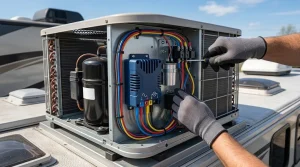
Low voltage at the campsite can reduce compressor efficiency and cause frequent circuit breaker trips.The compressor motor must overcome high voltage when starting,which requires a massive starting current.We recommend installing an advanced electronic soft starter in the electrical panel of your rooftop air conditioning unit.A soft starter smooths out the motor’s starting current,reducing the initial power surge by up to 65%.This ensures that your RV air conditioner starts smoothly even when connected to a low-voltage campsite outlet or a portable inverter generator.
External Insulation Strategies
Temperature Reduction by Exterior Heat Mitigation Strategy
| Mitigation Strategy | Thermal Mechanism | Interior Temperature Drop | Ease of Implementation |
|---|---|---|---|
| Reflective Window Inserts | Reflects radiant infrared heat | 5°F to 8°F reduction | Very High (Fast DIY) |
| Patio Awning Deployment | Shades southern vehicle sidewall | 4°F to 6°F reduction | High (Manual/Power roll) |
| White Roof Coating | Bounces 85% of solar rays | 8°F to 12°F reduction | Moderate (Requires prep) |
| Natural Tree Shade | Blocks direct overhead sunlight | 10°F to 15°F reduction | High (Site selection) |
8. Block Solar Heat Gain Across Windows
Solar radiation entering the vehicle through large glass windows significantly increases the heat load inside the cabin.You can cut custom double-layered reflective aluminum foil to fit all side and rear windows.Apply the reflective patches directly to the window glass to reflect infrared heat away before it enters the vehicle.You can even pull down pleated day-night shades to create an additional insulating layer of air.Next,install an external vinyl or mesh sunshade on the windshield;blocking heat radiation from the exterior glass surface prevents the interior glass from radiating heat into the car.
9. Park Wisely for Natural Shade
Analyze the campground layout and position your RV so that the awning faces west.Unfold the large awning to create a barrier against the intense afternoon sun.Park under the shade of mature trees whenever possible;this can reduce the temperature of the RV’s roof by about 20 degrees.

10. Use Auxiliary Fans to Improve Cooling Performance
The air inside an RV tends to stagnate,with hot air pooling near the ceiling and in the corners.You can place a portable 12-volt oscillating fan to direct airflow downward.This allows the cooler air near the floor to mix with the warm air near the ceiling,and the resulting balanced air circulation will keep the temperature comfortable and consistent throughout the RV.If you don’t have an oscillating fan,you can also use a small tabletop fan to increase evaporative cooling through your skin.You can set the thermostat a bit higher while still maintaining a comfortable ambient temperature.
11. Apply Reflective RV Roof Coating
Provided it complies with your local laws,you can apply a coating to the roof to reduce its temperature.Dark-colored or weathered rubber RV roofs absorb solar radiation and radiate heat downward onto the roof.Thoroughly clean EPDM,TPO,or fiberglass roof surfaces using a specialized rubber roof cleaner.Be sure to let the roof membrane dry completely before applying a primer and reflective coating.Roll on two thick coats of pure white silicone or elastomeric reflective roof paint.High-quality white silicone paint can reflect up to 85% of solar radiation.
Contact Us Now
- RM901 No.22 Tangjiaqiao Road Wenzhou China
- +86 138 1973 9327
- [email protected]
- https://www.autosparesupplier.com/
Share