
What is Gravity Casting? How It Differs from HPDC
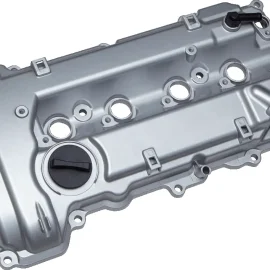
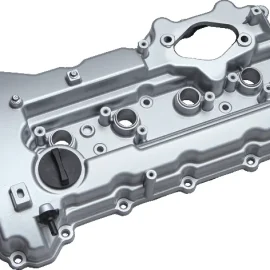
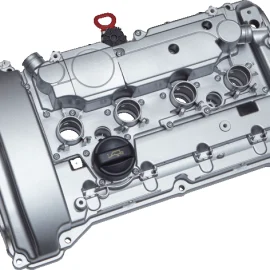
Gravity casting (GC) is a permanent mold casting process that relies solely on gravity to fill the mold with molten metal,producing engine valve covers.This traditional method relies on the earth’s natural force.It stands in sharp contrast to other methods like high pressure die casting (HPDC). While HPDC uses force,GC uses a gentle pour.
Understanding the Gravity Casting Process
This process is relatively straightforward.
First,a high-quality mold is fabricated,typically from steel or cast iron.
Next,a refractory coating is applied to the mold surface.The mold is then subjected to heat treatment.
Finally,molten aluminum is poured into the mold from the top.It allows the molten metal to fill the mold cavity slowly and smoothly.
This smooth flow is an advantage.It minimizes air turbulence inside the mold.Consequently,there is less trapped gas in the final part.This creates a denser metal structure than some other methods.However,it requires a longer cycle time to cool and solidify.
Get A Quote Now
Gravity Casting vs. HPDC
The Pressure Difference
HPDC uses massive pressure.This allows for extremely thin walls.GC relies only on the weight of the metal.Therefore,the walls must be thicker to ensure the metal flows everywhere.
Tooling and Speed
HPDC molds are complex and expensive.However,they produce parts in seconds.GC molds are cheaper to make.Yet,the production cycle takes minutes,not seconds.
For mass-produced valve covers,HPDC is usually the winner.
However,for lower volumes,GC is more cost-effective.
Process Comparison
| Feature | GC | HPDC |
|---|---|---|
| Filling Force | Earth’s Gravity (Low) | Hydraulic Piston (High) |
| Wall Thickness | Minimum 3mm – 5mm | Minimum 1.5mm – 2mm |
| Production Speed | Slow (Low Volume) | Very Fast (High Volume) |
| Porosity | Low (Dense metal) | Higher (Trapped air) |
| Heat Treatment | Possible (T6 capable) | Difficult (Blistering risk) |
Why Use Gravity Casting for Valve Covers?
Based on our decade-plus experience manufacturing valve covers,certain valve covers require complex internal geometries.These shapes may necessitate the use of sand cores to create hollow sections.
The GC process accommodates sand cores,as its gentle pressure does not damage them.
In contrast,high-pressure casting would instantly crush the sand cores.
Additionally,components produced via GC can undergo heat treatment.This process offers distinct advantages when valve covers require high strength.The metal material exhibits lower porosity,enabling it to withstand strengthening processes that high-pressure castings cannot endure.
It is precisely this exceptional durability that leads some enthusiasts to favor metal valve covers over plastic or aluminum alternatives.
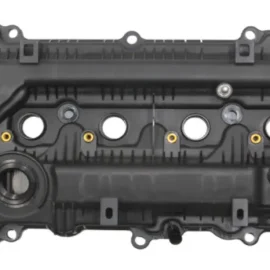
For ordinary passenger cars,plastic or aluminum valve covers offer better value for money and provide perfectly adequate performance.
Cost and Quality Analysis of Gravity Casting
| Scenario | Tooling Cost (Upfront) | Unit Cost (Per Part) | Best Method |
|---|---|---|---|
| Prototyping (1-10 pcs) | Very Low | High | Sand Casting / 3D Print |
| Small Run (100-5,000 pcs) | Moderate | Moderate | GC |
| Mass Production (100k+ pcs) | Very High | Low | HPDC |
Finishing and Aesthetics
Parts made via GC have a good surface finish.It is smoother than sand casting.However,it is not as glass-smooth as HPDC.
Typically,these components require machining.The sealing surfaces must be machined to prevent leakage from the valve cover gasket.The gasket requires a perfectly flat contact surface to achieve a tight seal with the engine.Due to the substantial wall thickness,ample material is available for machining and trimming,ensuring the components possess a robust and durable feel.
Contact Us Now
- RM901 No.22 Tangjiaqiao Road Wenzhou China
- +86 138 1973 9327
- [email protected]
- https://www.autosparesupplier.com/